
Annapurna Circuit vs ABC: Full Comparison Guide
The first time I saw the Himalayas, I thought I understood scale. Then the clouds lifted over Manang, and the mountains laughed at me.
By the end of that month, I’d walked beneath hanging glaciers, crossed a pass higher than any sky I’d ever known, and learned the simple magic of breathing slowly. Weeks later, standing in the silent bowl of the Annapurna Sanctuary, I realised: not every trek is about distance. Some are about depth.
Both the Annapurna Circuit and Annapurna Base Camp (ABC) will change how you see mountains—and yourself. One unfolds like an odyssey through changing worlds; the other feels like a pilgrimage into the heart of one. This guide helps you choose the path that fits your time, fitness, and spirit.
Two Routes, One Himalayan Soul
Both routes lie in Nepal’s central Annapurna region—an amphitheatre of peaks, prayer flags, and cultures stitched together by the same rhythm of footsteps and laughter. If you’ve sat in a Pokhara café watching trekkers prep packs, you’ve seen both energies: the long-road planners eyeing Thorong La and the calm souls who know they’ll be sipping tea in Chhomrong in a few days.
| Feature | Annapurna Circuit | Annapurna Base Camp |
|---|---|---|
| Duration | 12–21 days | 7–12 days |
| Max Altitude | 5,416 m (Thorong La Pass) | 4,130 m (Base Camp) |
| Distance | ~160–230 km (route dependent) | ~110 km |
| Style | Loop around the Annapurna Massif | Out-and-back into the Sanctuary |
| Difficulty | Moderate → Strenuous (high pass) | Moderate (shorter, lower ceiling) |
| Best Seasons | March–May / Sept–Nov | March–May / Sept–Nov |
Quick take: If you have time and crave variety, the Circuit will test and transform you. If you want intimacy, impact, and altitude in under two weeks, ABC delivers pure Himalayan magic—fast.
Annapurna Circuit Comparison — Walking Through Worlds
It begins in the green. Morning mist on rice terraces. Children calling “Namaste!” from doorways. The air smells of wet soil and cardamom tea. By noon, waterfalls roar beside the trail and porters move like rhythm itself—loads balanced, sandals tied to packs for later.
Every day takes you higher. Banana leaves give way to pine; humidity trades places with altitude. Around Pisang and Manang, the air is thin and dry, prayer wheels click under your palm, and hillside monasteries flash red and gold in the wind.
Then comes Thorong La Pass (5,416 m)—ice, wind, and willpower. You start before dawn, headlamps carving halos through the dark. Every breath feels earned, every step deliberate. At the ridge, the horizon detonates into colour—white peaks, blue sky, flags snapping like sails. You look down into Mustang’s ochre cliffs and understand why people call this trek a pilgrimage.
The descent rewrites the world again: apple brandy in Marpha, pilgrims bathing at Muktinath, hot springs in Tatopani. By the time you loop back toward Pokhara, you’ve crossed climates, languages, and a few parts of yourself you didn’t know were there.
Why choose it: Evolution, variety, achievement. The Circuit is a moving atlas—Nepal turning its pages beneath your boots.
Internal link: Best Time to Trek Nepal
Annapurna Base Camp — Into the Sanctuary
ABC starts softly, with birdsong and rain-damp leaves. You pass buffalo grazing in the mist and follow the river toward villages where dal bhat tastes like comfort itself. Soon the trail rises into rhododendron forest, glowing even on cloudy days. Ferns brush your legs; streams tumble over mossy stones; every corner reveals a new teahouse and a new smile.
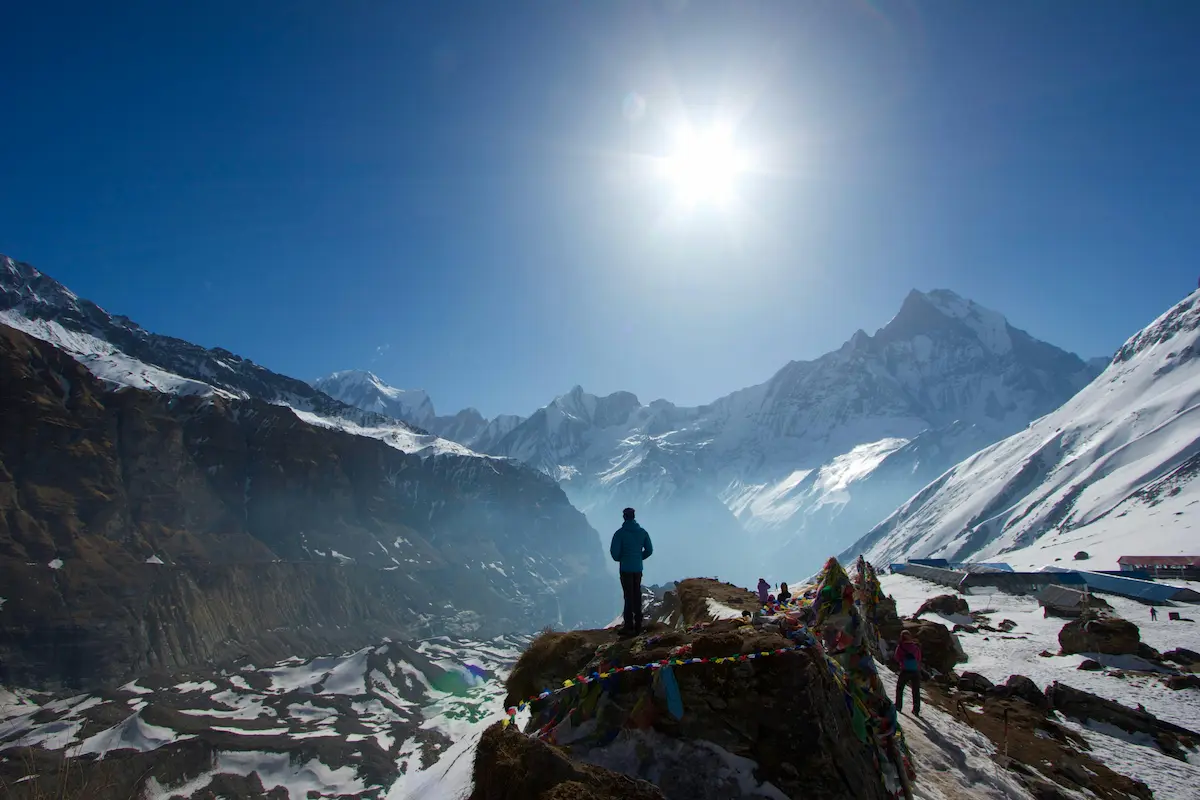
At Chhomrong, rooftops spill down a hillside of stairways, and the snowfields feel close enough to touch. Higher still, bamboo gives way to scrub and stone. Nights sharpen; stars crowd the sky. At Machapuchare Base Camp, peaks feel impossibly near, and the last climb to ABC (4,130 m) is just wind, breath, and anticipation.
Dawn spills over the 8,091-metre wall of Annapurna I, then brushes Machapuchare until the whole Sanctuary glows gold. It’s not the breadth of the Circuit—it’s intimacy. The Himalaya at whisper range.
Why choose it: Focus, closeness, time-efficiency. ABC is a perfectly cut short story—every line deliberate.
Check our prices for Annapurna Circuit here: How Much Does a Nepal Trek Cost?
Annapurna Circuit Comparison: Duration, Difficulty & Daily Rhythm
Annapurna Circuit
Plan: 12–21 days, depending on pace and whether you take jeeps to skip road sections. Expect 6–8 hour days; Thorong La day can nudge nine. Altitude builds gradually—great for acclimatisation, humbling for the ego.
Annapurna Base Camp
Plan: 7–12 days. Expect 5–7 hour days of stone steps, forest climbs, and teahouse evenings. Altitude is friendlier; recovery is quicker; conversation flows around the stove.
Plain-speak: The Circuit is a marathon of changing worlds; ABC is a focused climb into stillness. Both reward patience more than power.
Internal link: How to Train for Everest Base Camp (the principles apply to Annapurna).
Scenery & Culture
Circuit = Variety. Subtropical terraces → alpine forest → high-desert Mustang. Monasteries, chortens, yak trains, frozen waterfalls. Every half day feels like a new chapter.
ABC = Intimacy. Gurung hospitality, wood-smoke kitchens, rhododendron petals underfoot. The story narrows until it’s just you and the mountains breathing together.
Seasons & Weather
- Spring (Mar–May): Flowers, softer light, warmer days—photographers’ delight.
- Autumn (Sep–Nov): Crisp mornings, crystal views, stable skies.
- Winter: Quiet but cold; Thorong La can close.
- Monsoon: Lush and alive, but slippery; landslides/leech season.
Tip: Late Nov or early Mar offers poetic light and quieter trails.
Logistics, Guides & Budget
You’ll need two documents for either trek: ACAP (Annapurna Conservation Area Permit) and a TIMS card. Since 2023, most visitors trek with a licensed guide—good for safety, local insight, and nimble route decisions if weather or health shifts.
- Circuit: ~US $1,200–1,800 (longer duration, remote logistics, optional jeep sections).
- ABC: ~US $700–1,200 (shorter route, simpler access).
Teahouses line both routes like pearls—each one serving dal bhat, blankets, and stories.
Highlights You’ll Never Forget
Annapurna Circuit
- Sunrise and flags cracking at Thorong La.
- Devotion and bells at Muktinath Temple.
- Apple brandy and quiet lanes of Marpha.
- Soaking at Tatopani hot springs.
- First snow dusting the peaks over Manang.
Annapurna Base Camp
- Poon Hill sunrise—peaks catching fire at once.
- Mist-wrapped forest from Bamboo to Deurali.
- Star-washed nights at Machapuchare Base Camp.
- The hush inside the Sanctuary at dawn.
Which One Is for You?
Choose the Annapurna Circuit if you…
- Have 12–21 days and love earning a horizon.
- Crave constant change—terrain, weather, culture.
- Enjoy challenge, solitude, and long, honest climbs.
- Don’t mind dust or using jeeps to shape your route.
Choose Annapurna Base Camp if you…
- Have 7–12 days and want the mountains up close.
- Prefer cultural warmth and a single breathtaking destination.
- Seek balance—physical challenge with spiritual reward.
- Want intimacy over conquest.
Personal Reflection
On our last trek, Sonia woke me before dawn at the Base Camp. “Listen,” she said. At first, I thought she meant the wind. Then I realised it was silence—the kind that hums. Moments later, the peaks blushed pink, and we both forgot to breathe. Months later, I could still hear that silence whenever I closed my eyes.
And on the Circuit? It wasn’t silence that stayed—it was movement: prayer wheels spinning, rivers whispering, Nepali songs drifting from teahouse kitchens. Adventure isn’t always about how far you go. Sometimes it’s about how deeply you arrive.
In writing an Annapurna Circuit Comparison its a difficult task to do – like comparing children or pets, they are different in many ways but they have there own unique special qualities.
Frequently Asked Questions
What’s the difference between the two treks?
The Circuit is a 160–230 km loop crossing Thorong La Pass at 5,416 m; ABC is a shorter ~110 km out-and-back to 4,130 m inside the Annapurna Sanctuary.
Which is harder?
The Circuit is tougher—longer and higher. ABC is moderate and perfect for fit beginners or time-limited trekkers.
When’s the best season?
Spring (Mar–May) and autumn (Sep–Nov) for clear skies and stable conditions. Winter can close Thorong La; monsoon is lush but slippery.
Do I need a guide?
Yes—licensed guides are now required in most protected areas, and they enrich the journey with safety, language, and local insight.
Can I combine both in one trip?
With 25–30 days, yes. Many trekkers loop the Circuit, then transfer to Pokhara for ABC.
Further Reading
Ready to Choose Your Path?
Whether you crave the wild sweep of the Annapurna Circuit or the spiritual hush of Annapurna Base Camp, our team crafts treks that honour both adventure and meaning. We keep groups small, acclimatisation smart, and storytelling alive—because you’re not just walking a trail; you’re walking into a story.
Start Your Annapurna Adventure
Compare our Annapurna treks or Plan a Custom Nepal Itinerary
Prefer a shorter Himalayan story? See our Everest Base Camp 2026 trek.
Good information thx for sharing
This post was super helpful! It clearly breaks down the differences between the two treks, covering difficulty, duration, scenery, and more. Thanks!